With the arrogance of youth, I determined to do no less than to transform the world with Beauty. If I have succeeded in some small way, if only in one small corner of the world, amongst the men and women I love, then I shall count myself blessed, and blessed, and blessed, and the work goes on. -- William Morris

Tuesday, December 11, 2007

Some Ponderings on Tolkien and the Inklings

In letter 131, Tolkien famously stated his desire to write a mythology for England. “There was Greek, and Celtic, and Romance, Germanic, Scandinavian, and Finnish (which greatly affected me); but nothing English, save impoverished chap-book stuff. Of course there was and is all the Arthurian world, but powerful as it is, it is imperfectly naturalized, associated with the soil of Britain but not with English; and does not replace what I felt to be missing,” J.R.R. Tolkien, The Letters of J.R.R. Tolkien. ed. Humphrey Carpenter (Boston: Houghton Mifflin Company, 1981), 144. Clearly the end result of this was the creation of Middle Earth, and the whole cycle of tales starting with The Silmarillion, going through The Hobbit and The Lord of the Rings, and ending as it were, in various unfinished works such as The Notion Club Papers. But was this always Tolkien’s plan? Was his Middle Earth cycle the only thing Tolkien worked on or considered as a way to create this British mythology? Perhaps the answer to this question is no, and Tolkien once pondered, started, but eventually abandoned a different cycle of tales to become his “British mythology.” If so, what would it have been?

The clue to this mystery comes to us in the very words provided above from letter 131. What if he once considered doing a medieval cycle of tales which would end with Arthur? Verlyn Flieger, who once tried to publish Tolkien’s unfinished work on King Arthur, suggests that this might actually have been the case. “The very fact that he raised the issue of ‘the Arthurian world’ suggests that he was not just aware of its place in England’s literary heritage but of its place in his own as well, for Tolkien had already tried writing his own version of Arthurian legend. At some time in the mid-1930s, more than a decade before he wrote the letter, he had begun a long poem that he called The Fall of Arthur,Verlyn Flieger, Interrupted Music: The Making of Tolkien’s Mythology (Kent, OH: Kent State University Press, 2005), 34. Before then, Tolkien had worked on and helped translate Sir Gawain and the Green Knight with E.V. Gordon. Moreover, if one looks at Farmer Giles of Ham, Tolkien specifically places it within an Arthurian perspective, happening after the time of Old King Coel and before the time of Arthur. Certainly Tolkien had an interest in Arthur and the Arthurian legend, even if he ultimately found it to be unsuitable to meet his needs. We can see influences of its cycle of stories and ideas consistently surrounding Tolkien and making its way into Tolkien’s stories (Gandalf is more than a little like Merlin, and one cannot discount the similarity between Aragorn with Arthur).

Yet, there seems to be something missing. While we have a few stories by Tolkien, some left unfinished, which show an Arthurian bias and might provide enough evidence to suggest Tolkien pondered the development of an Arthurian cycle to appease his own desire for a mythology for Britain, certainly it was not the only thing he wrote upon or worked on during the time he was writing these Arthurian stories. He was still working upon his own Middle Earth stories. He might have had plans to connect the two together, and to show how Middle Earth and its pre-history slowly became the Britain of history and especially of Arthurian legend. But it also seems if this was the case, he might have also desired other mythmakers to share in this task. And this is where the Inklings have a place in this story. Myths and legends clearly need more than one source and one author to develop properly and engage the psyche of a culture. While Tolkien tried to create a mythology which displayed the influence of many editors involved in its creation, for the most part it was all to do with his pre-historical world. However, this interest in Arthur and the possible development of an Arthurian mythology was an idea held not just by Tolkien but other Inklings, such as Charles Williams and C.S. Lewis. If we look at the literary efforts of the Inklings, we can see an interesting, over-arching legacy of stories which could be seen as connecting one to another: Adam Fox’s Old King Coel leads into Farmer Giles of Ham which then leads to all the Arthurian tales written by Williams and Tolkien, and finally ends in Lewis’s That Hideous Strength (written, as it were, in the style of Williams to honor Williams after his death). And, somewhere within that history, one would have found a place for Tolkien’s Smith of Wooton Major.

While this might, at first, seem to be a fanciful reading of the Inklings, we must remember that Lewis’ Space Trilogy, begun with Out of the Silent Planet was originally meant to be followed by a time-travel tale written by Tolkien. The tale Tolkien began was clearly within his Middle Earth tradition. But Lewis was impatient with Tolkien and wrote the rest of the trilogy by himself. The last volume of the Space Trilogy contains the first published reference to Tolkien’s own Numenor, placing it side by side with the novel's own Arthurian references. And even if Tolkien would eventually make his Middle Earth cycle his claim to fame and use it to satisfy his own personal need for a British mythology, we must remember, the Old English texts he worked with as a philologist, consistently called the world in them “Middle Earth.” It could be said that, for Tolkien, the greatest problem with the Arthurian legend is that it was too recent, too Christianized, but it seems that there is always a place, even if it is a minor place, for it and the literature surrounding Arthur made by the Inklings to become a part of the greater story which forms Tolkien’s mythology.

Labels: ,

Wednesday, June 06, 2007

Tolkien on Scandal in the Church

"'Scandal' at most is an occassion of temptation -- as indecency is to lust, which it does not make about arouses. It is convenient because it turns our eyes away from ourselves and our faults to find a scape-goat. But the act of will of faith is not a single moment of final decision: it is a permanent indefinitely repeated act > state which must go on -- so we pray for 'final perseverance.' The temptation to 'unbelief' (which really means rejection of Our Lord and His claims) is always there within us. Part of us longs to find an excuse for it outside us. The stronger the inner temptation the more readily and severely shall we be 'scandalized' by others. I think I am as sensitive as you (or any other Christian) to the 'scandals', both of clergy and laity. I have suffered grievously in my life from stupid, tired, dimmed, and even bad priests; but I now know enough about myself to be aware that I should not leave the Church (which for some would mean leaving the allegiance of Our Lord) for any such reason: I should leave because I did not believe, and should not believe any more, even if I had never met any one in orders who was not both wise and saintly."

--- Letter 250, to Michael Tolkien. In The Letters of J. R. R. Tolkien. ed. Humphrey Carpenter (Boston: Houghton Mifflin Company, 1981).

Labels: , ,

Thursday, May 31, 2007

Some Thoughts on Three Representations of the Antichrist

From time to time, one finds Solovyov’s description of the Antichrist, as found within his work, War, Progress, and the End of History, used in a homily or sermon by one preacher or another. When this is done by someone famous, their homily is usually given a sensationalistic interpretation. Recently, Cardinal Biffi’s lenten homily, as was delivered on March 4, 2007, presented aspects of Solovyov’s description of the Antichrist. What sparked the interest of many here was when Biffi’s said, “The Antichrist will be a ‘convinced spiritualist’ Soloviev says, an admirable philanthropist, a committed, active pacifist, a practicing vegetarian, a determined defender of animal rights.”

It did not take long before reflections were written, saying that if the Antichrist is to be a philanthropist, a pacifist and a vegetarian, then there must be something inherently bad about these qualities.

Few people have actually read any Solovyov, and they do not know how and why Solovyov described the Antichrist in this fashion: they were the beliefs and practices of one of Solovyov’s theological and philosophical opponents, Leo Tolstoy. Solovyov did to Tolstoy similar to what Dante did to his enemies: he represented Tolstoy in a vilified form. But there is more to the story, more to the point than this (one can say the central point of War, Progress, and the End of Human History was a refutation of Tolstoy’s unbending ways; but the story of the Antichrist was only the ending of the work, using the Antichrist as an allegory for what can go wrong with Tolstoy’s vision –and what this is we shall see later).

Solovyov did not want to suggest that these (or similar like-minded) characteristics were evil. Separated from a holistic good, they are, certainly, but the same can be true with many other goods. Instead, because there is good in these qualities, Solovyov was showing how and why the Antichrist will not appear on the scene as if he were evil incarnate. Indeed, he will do a considerable amount of good, and that good is what will attract followers. This does not mean we should do the opposite of what the Antichrist does, but rather understand how his actions only apparently follow good, moral behavior; they do so only in a manipulative fashion: one could rather say he abuses the moral laws rather than follows them. Not only will the Antichrist appear good, he might even intend to do what he believes is good, but what he ends up doing will only be a perversion of that good.

We live in a time when speculations about the end of the world are popular, and many people look for signs and wonders which prove to them they are living at the end of human history. This is not a new phenomenon; looking back, we see it is a common theme in Christian thought. While there is some sort of temporal hubris involved (we often want to think that we live at the end of history, meaning, that we live in one of the most significant human eras ever), there is much more going on. There are reasons why our desires seem to be met: because the forces of the Antichrist continually to exist side by side with Christendom. It is easy to see the work of the Antichrist around us. Many believe that these forces will only be seen at the end, and therefore, if we see them, we must be nearing that end. There is a truth in this – from the time of Christ on, we are living out that end, however, we must not expect that the final events of history are going to be seen in our time.

In his textbook on Eschatology, Pope Benedict XVI provides us some significant insights on the antichrist. There will be a series of antichrists, living in different ages, each representing an aspect of the dark forces at work in the world; however, there will also be one final Antichrist, the culmination of all that has gone before him. The first hints of the Antichrist come from Daniel 11:36 and Ezekiel 28:2, but they are first and foremost descriptions of individuals living in the times of Daniel and Ezekiel; but these people (Antiochus Epiphanes and the Prince of Tyre) are also types of the final Antichrist. “The fact that the future antichrist is thus described with features which originally belonged to two other figures from the distant past naturally deprives him of any very well defined uniqueness. It situates the antichrist of the End within a series where a long line of predecessors have already nursed the evil that comes to its supreme intensity in him.” Joseph Ratzinger, Dogmatic Theology 9: Eschatology. Trans. Aidan Nicholas (Washington, DC: CUA Press, 1988), 196.

Literature and theological speculation on the final Antichrist is difficult to write because of the rather vague description we have of him. Yet, such reflection is important. An individual author may not be able to perceive the whole of the Antichrist, but they can represent aspect of him to us. Usually they do so, like Solovyov, by raising a philosophical or theological question, and having it played out in their writings.

Within some circles, this kind of story has become very popular, and anyone writing it with a semblance of literary merit and a sufficient amount of advertising and self-promotion becomes a best-selling author. There is a now considerable amount of such literature out there, most of them are quite bad, like the Left Behind series, and for some reason or another, the best of them are often neglected. Even an author like C. S. Lewis, who is otherwise popular, has had his insights ignored by the current generation (perhaps because they do not like how his story challenges their beliefs about what the Antichrist will be like).

One of the most unusual, and most obscure, presentations of an Antichrist (the story does not decide if he is the final one or not) is in Charles Williams’ novel, Shadows of Ecstasy (Grand Rapids, Michigan: William B. Eerdmans, 1980). Here is a story about a man, Considine, who is a superman – he has found a way to extend life indefinitely – he does not age, but he can die if shot or harmed in some similar fashion. He learned how to extend his life through esoteric means while living in Africa, but he believes them to be entirely natural, entirely human. It requires us to transform the passions we have, to keep a hold of them, and use the energy of them to preserve our life. “When your manhood’s aflame with love you will burn down with it the barriers that separate us from immortality. You waste yourselves, all of you, looking outwards; you give yourselves to the world. But the business of man is to assume the world into himself. He shall draw strength from everything that he may govern everything”(72). Through some sort of tantric-like manipulation of love and desire, we can transform the energies associated with our passions; by this method, Considine suggests that we even have the power to conquer death. “Why does a man die but because he had not driven strength into the imagination of himself as living?” Considine asks one of the heroes, Sir Bernard (73). But of course in this reshuffling, desire becomes all and nothing, it kills the spirit within while life remains within its shell. It can never be transfigured, it can only live on.

One can only live so long in this state before wanting more. Thus Considine and his followers believe that just as there is a way to extend life, death must be overcome by man. “Because I live, men shall live also. But they shall do greater works than I, or perhaps I shall do them – I do not know. To live on – that is well. To live on by the power not of food and drink but of imagination itself recalling into itself all the powers of desire –that is well too. But to die and live again, that remains to be done, and will be done” (75). Until that point, man must preserve and conserve themselves, and life becomes a living death, where one should not “waste” one’s power on because one first needs to use that power to discover and control oneself. But in the conquest of death, everything changes. “It’s possible to make out of the mere superfluity of power greater things than men now spend all their powers on. The dropping flames of that fire are greater than all your pyres of splendour. And when death itself is but a passion of ecstasy, we will make music such as you couldn’t bear to hear, and we will be the fathers of the children who shall hear it” (80).

Until it is done, Considine is training his followers (and himself) in the art of living and dying, with the belief that one follower will find the right way to overcome death itself. Considine, ever the manipulative gentleman, controls key figures throughout the world, protecting him and his experiments – experiments which require people to commit suicide and to attempt the conquest of death in themselves. One such man, Simon Rosenberg, nearly succeeds – there is a scene, days after his suicide, where his body begins to stir, and signs of life are seen by Considine’s followers: then it is over, and death claims its victim. In the end, Considine is himself killed, but we are left wondering: will he be the one – and in this fashion become the ultimate representation of man against God, that is, will he be the final Antichrist? Or does he and his followers just represent one great step along the path which leads to the Antichrist, and someone greater is yet to come?

Charles Williams, like Vladimir Solovyov, wrote upon what he knew and understood best. This, the first of his novels, perhaps best represents one of the central themes of his supernatural thrillers: the dangers of esoteric knowledge and how it can be abused. Williams, one of the Inklings, was a scholar in the field of the occult, at once intrigued by it, even drawn to it, yet with a Christian sensibility to know the danger which lurks behind it. Thus Williams’ representation of the Antichrist best represents the charismatic, hypnotic powers of such a man, and the darkness which consumes one who tries to be a humanitarian superman. It’s every bit a condemnation of the nihilism of Nietzsche as it is a condemnation of the occult, and it shows how the two ultimately are one and the same.

C. S. Lewis in The Last Battle (New York: Collier Books, 1978) represents a different approach on the Antichrist. The theme of the work is more about the significance of the end of history and what happens after we reached that end than it is a discussion of the Antichrist. Yet, it presents to us a rather unique picture of the Antichrist, in part, because it represents many of Lewis’ eschatological speculations. Lewis, like George MacDonald before him and Balthasar after him, held a high hope for the salvation of all – although, unlike MacDonald, he did not believe one can know if this hope will be achieved. Is it realistic for one to possess this hope? Won’t the Antichrist, the personal culmination of evil in the world, be too far gone to be saved? Lewis answers this question in the negative.

Despite its fantasy nature, Narnia is seeped in allegory, and it is very easy to spot whom Lewis made as the Antichrist and whom he made as the False Prophet. But there is a twist in the tale here: while one thinks of the Antichrist as being the one in charge, in Narnia, it is the False Prophet, the talking-Ape Shift who has the Antichrist, the talking-donkey Puzzle, as a figurehead under his control.

Puzzle was a rather decent, but easily manipulated, creature; he did whatever his friend Shift told him to do. But throughout the story, one can tell that Puzzle is always a bit perplexed, and his compassionate, good-natured self is often brought to the forefront. Shift uses it to his advantage, and always coerces Puzzle to do his will, saying how unkind or ungrateful Puzzle is if he doesn’t.

When Shift and Puzzle find a lion-skin, the difference between the two is obvious. Puzzle mourns the death of the lion and wants to bury the skin; Shift does not; rather he thinks of what use he could make of it: he wants to use it to turn Puzzle into a false-Aslan. Shift has no reverence for anyone, and no respect for his friend; he just looks for what he can get out of others. Puzzle reveres Aslan, and believes that respect should be shown to all lions because Aslan is himself a talking lion and all lions are in his image. Thus he suggests to Shift, “Even if the skin only belonged to a dumb, wild lion, oughtn’t we to give it a decent burial? I mean, aren’t all lions rather – well, rather solemn. Because of you know Who? Don’t you see?” (6) Shift only responds with contempt, saying that Puzzle is not too bright and he should just follow what Shift tells him to do. And so Puzzle does this, helping to bring about the end of Narnia itself.

Shift gathers followers around him who do his will, fighting for control over Narnia. He makes a deal with Calormenes, enemies of Narnia who worship the brutal false-god, Tash. Indeed, he tells everyone that Aslan and Tash are one and the same, and yet he does this, not to discourage false religious practices, but to encourage a false unity between the two faiths. This must be read in context with what has Aslan say in the end of The Last Battle There is some measure of truth in it – what Shift said is as true as it is false, and that truth is what gives his message some strength. For in the story we learn of one Emeth, a good Calormene, and his encounter with Aslan:

The Lion growled so that the earth shook (but his wrath was not against me) and said, It is false. Not because he and I are one, but because we are opposites, I take to me the services which thou hast done to him, for I and he are of such different kinds that no service which is vile can be done to me, and none which is not vile can be done to him. Therefore if any man swear by Tash and keep his oath for the oath’s sake, it is by me that he has truly sworn, though he know it not, and it is I who reward him. And if any man do a cruelty in my name, then though he says the name Aslan, it is Tash whom he serves and by Tash his deed is accepted. (165).


The truth behind the fiction that Shift told is that one who believes they are following Tash could in truth be following Aslan; the name, though meaningful, is secondary to the heart; if one loves truth and seeks for goodness, they will find it. Even if they were led to believe the search is to be done through a falsehood such as Tash, in the end they will find what they thought to be Tash was really Aslan.

This paves the way for Lewis’ unconventional understanding of the Antichrist. Puzzle, ever beguiled by his simple but good nature, trusts his friend, and it in that trust, in the purity of his heart, that we find that goodness remains. Such goodness, Lewis suggests, can only end in triumph, and with the The Last Battle this means the salvation of Puzzle.

Like Williams, Lewis offers us a unique vision of the Antichrist, and he provides for us some things to ponder. We often believe that the Antichrist will be the one in control, and yet it is also believed that he will hold some power-mad scheme which makes him obviously evil. In Lewis, we find the exact opposite: Puzzle is kind and considerate, but he is also rather simple minded. He has no malice in his heart; yet it is because of his simple nature, that he can be used as a figurehead for evil. Evil, by its nature, can only exist in and through the good, it can only corrupt, it cannot create. The ultimate evil cannot exist without some good; it won’t be followed except for the fact it will look and appear that what it offers is not evil, but good.

This brings us back to Solovyov and his vision of the Antichrist. His representation combines elements of Williams and Lewis together. Here we have an Antichrist who begins his mission as a humanitarian; he truly wills to do good. “At that time, there was among the few believing spiritualists a remarkable person -- many called him a superman – who was equally far from both, intellect and childlike heart both. […] Conscious of the great power of spirit in himself he was always a confirmed spiritualist, and his clear intellect always showed him the truth of what one should believe in: the good, God, and the Messiah. In these he believed but he loved only himself.” Vladimir Solovyov, War, Progress, and the End of History. Trans. Alexander Bakshy, revised by Thomas Beyer (Hudson, New York: Lindisfarne Press, 1990), 165.

Here we have a superman, one with powers and skills beyond everyone else, but he has one flaw – he loved only himself. But what a flaw it is! The same flaw we have with Considine, we see in Williams’ vision of the Antichrist. But, unlike Williams, Solovyov goes forward to show the consequence of this love – to show the true power of the Antichrist. He followed the good only so far as it helped him, but he would – and did – bow to the Evil One when offered the kingdoms of the Earth. He turns from a believer of Christ to his great denier – seeing Christ as only a type of himself. His book, The Open Way to Universal Peace and Prosperity, brings about what it claims: world peace and an end to famine, with him as its ruler. “The new lord of the world was above all else a kindhearted philanthropist and not only a philanthropist, but even a philozoist, a lover of life. He was a vegetarian himself, prohibited vivisection, and instituted strict supervision over the slaughter-houses; while societies for the protection of animals received from him every encouragement. But what was more important than these details, the most fundamental form of equality was firmly established among humankind, the equality of universal society” (171).

All this appears good and holy, and yet he held for himself alone love and respect, and he had grown to hate Christ, even to fear him. To lift himself up, he must make Christ as naught; he must create a universal Christian faith which believes in nothing but has himself, not Christ, as its defender. Most Christians are fooled, but a few, including the representative heads of the Catholic, Protestant and Orthodox traditions, are not. This brings down his wrath – showing the extreme bitterness and hate contained within his heart.

While Williams brings to us a superhuman, hypnotic Antichrist, filled with esoteric power, and Lewis brings us the beguiled, good-natured Antichrist, Solovyov provides for us not just an Antichrist who fools us with his apparent goodness, but with an Antichrist whose goodness is lost because of his own self-love. He who desires to be the greatest must be the least; we must die to our selves to be resurrected in Christ. In this reason we can understand Solovyov’s point. The qualities he gives to the Antichrist can be anything which we perceive to be good, but no matter what we believe them to be, they can be lost by those whose love is only themselves; and whatever good Tolstoy represents, Solovyov believed, was lost by his pride and grandiose personality. For what other reason could Tolstoy be led to claim Christ and yet reject the Church Christ established (in any objective manifestation of it)?

Labels: ,

Thursday, May 17, 2007

Owen Barfield Quote

"A work of art, then, is characterized, not by the absence of distinct parts, on the contrary, by the greatest possible distinctness and self-sufficiency of its parts -- provided only that we do not think of them as mutually impenetrable. It is equally clear that interpenetration is a quality which the parts possess, not as mere objects, but precisely as being (a) wholes in themselves and (b) 'parts' of the same whole. They interpenetrate and are pro tanto inseparable, not because the whole is a formless waste, but because the hole has form, and that form enters into each of them. Can we therefore go further and affirm that the ideal organic relation of the part to the whole is a sort of identity of the one with the other? That, in musical terms, ideal counterpoint is fugue -- where the whole melody is found again in each part? Now, according to Soloviev, this is or ought to be true of human society -- that the whole of which individual men are the 'parts.' Not only man in general, but each individual man 'may become all' (he says), as he lives and learns to do away with that inward boundary which severs him from the rest.

"And again: the ideal 'person, or embodiment of the idea, is only an individualization of the all-oneness, which is indivisibly present in each of its individualizations.' Thus, in the 'all-one-idea' realized, the part is the whole, not by merger, but by the contrary by intensive development of its true individuality or part-ness. Or rather the whole is the part; for, whereas when we think abstractly about being, as in the process of logic and classification, the whole is predicated of the part, so that we say, 'A horse is a quadruped,' in the actual process of being, the order is reversed, and the race or archetype is the species or individual -- because it gives it being. "

---- Owen Barfield, "Form in Art and Society," in The Rediscovery of Meaning and Other Essays (Middletown, Connecticut: Wesleyan University Press, 1977), 221-2.

Labels: , ,

Thursday, February 22, 2007

And Now For Something Different....

I got a copy of Windows Movie Maker this week, and decided to experiment with it. I put together a tribute to the Inklings, highlighting their most influential works (The Lord of the Rings and The Chronicles of Narnia), their friendship, and the love that C.S. Lewis and J.R.R. Tolkien had for their wives. Be sure to spot: J.R.R. Tolkien, C.S. Lewis, Owen Barfield, Charles Williams, Warnie Lewis, Christopher Tolkien, Edith Tolkien and Joy Gresham!


The music used in the video is "Song for Ten" by Murrary Gold, performed by Neil Hanson, from the Doctor Who Original Television Soundtrack.

Labels: ,

Tuesday, February 20, 2007

Charles Williams Quote

The central mystery of the Mass has been at all times the subject of dream and speculation, of theology and devotion. If it is the centre of Christian life, it is also and therefore, the centre of all life -- anyhow on this planet, and perhaps everywhere. For the mystery of the Redemption -- of which this is the sign and means -- lies close to the mystery of Creation. The Sacrifice of the Crucifixion was the unmaking of all life that it should be remade after the great original pattern; a deliberate unmaking instead of an inevitable decay. So far as chaos could come again upon a world in which God was immanent, so far in that darkness it came; wounding and overwhelming the Sacred Body, inclosing and darkening the Sacred Spirit within. It is the nature of Omnipotence always to be able to endure more and to go farther than the utmost that can be brought against him; and perhaps this is the nature of the last Judgement, that He leaves to every man the choice of dealings with Him. If a man will shape his life upon a basis of pride and anger, then he shall find a greater pride and anger in God; if he is covetous and robs others, God shall be covetous and rob him; if he is full of love, then God shall be full of love. The Mass is an invisible communication, not only of redemption but also of creation and judgement: it is an absorption of the communicant in his degree into eternity. It is therefore above all things the relation between his own soul and Love with which the lover is concerned; and though he passes into the mystery by the channels which Love has prepared, Love itself issues therefrom in all his terrible strength along the channels which the lover has prepared.


--Charles Williams, Outlines of Romantic Theology (Berkley, California: Apocryphile Press, 2005), 43.

Labels: , ,

Wednesday, February 14, 2007

On Academic Theology

What exactly should the role of theology be in academia? In the modern world, the two disciplines almost seem to be at odds with one another. Even if we recognize that the most proper form of theology is doxology, that loving, prayerful response to one’s encounters with God, the practice of theology as a scientific discipline (as St Thomas Aquinas calls it) requires the theologian to study and investigate not just their own experiences of God, but what has been experienced and taught by others, especially the movement of the Holy Spirit working in the Church throughout history. They need to know what it is the Church proclaims; they need to know not just the words, but the intent and meaning behind her dogmas. They must understand that the way we define words changes from age to age. Thus, they must be made capable of properly reading creedal statements and interpreting them so that they make sense to the people who live in their own day and age. To do this, they must look into the sources of Christian doctrine. They must discern how and why different doctrinal positions developed, because this will reveal what a specific doctrine was meant to teach, and what it did not teach.. But there should be a purpose in all of this. Theologians are not meant to be curiosity seekers, looking for interesting facts to display; they are looking to understand their own relationship with God, and finding a way to bring that understanding to the community, for the good of the community and not for any individual glory. Their investigation should be to build up the faith, not to destroy it. They should seek to overcome confusion, not to add to it.

Academia, however, has a different intent. While once it was a pursuit of truth, now it is a pursuit of glory. Academia desires new ideas, new thoughts, and new traditions to argue over, to contend with, so that its practitioners can easily find an outlet for their writings. Academics are expected to publish, and their publications are expected to be new, improved analyses, overturning the way people used to understand their respective academic disciplines. It seeks to investigate, just as a theologian does, but for a different reason than a theologian would. It seeks to deconstruct the past as a means of overcoming its influence, so that the academic’s position can be accepted as the new norm to be followed. That is, if they have a position – many times, there is no reconstruction, there is merely a deconstruction; it is easier to cause doubt, to bring fire to the ideas of the past, than it is to rise out of the ashes, a phoenix.

When one combines the art of theology with modern academia, it is quite understandable why this new discipline, academic theology, is often a nihilistic wreck destroying the faith of its practitioners and its readers. There are many bright lights in the field, showing that the field itself is not without merit. Indeed, when it is done properly, it is a rather important endeavor and those who do it properly should be thanked for the contributions they have given to the world. But there are far more dim lights, far more black holes trying to snuff out whatever light that still exists, than there are these bright lights, and as time goes by, fewer and fewer bright lights seem to be born in the field. This could change in the future, and let us pray toGod this happens. But currently, as one who engages the discipline, I find the field to be in utter shambles, and there are many reasons for this.

First, the field follows the academic discipline in trying to deconstruct the past. Let me state that I agree with this, as far as it goes. We need to understand the past, and with it, we need to understand where our theological teachings come from, including the presumptions which helped shape their proclamation. But academics often feel, once you deconstruct the past, and show that a given teaching developed only as a result of a specific historical situation, you then remove all value of the teaching itself. This kind of historical criticism has led many theologians to doubt their faith, and when this study is not brought back to some sort of positive affirmation of the faith (as, sadly, is most often the case), it is not surprising that these studies end up destroying the faith of those who read them and those who make them. Of course, the academic, though they should know better, has fallen for a rather peculiar form of ad hominem. While it might be true that a given teaching arose out of certain circumstances, and those circumstances might not have been ideal, those circumstances alone do not determine the truth or falsehood of that teaching. The moral character of a teacher does not entirely determine the accuracy of their teachings; nor does the fact that a teacher gave inaccurate justification for a teaching mean that teaching is necessarily wrong.

Secondly, the field follows academic discipline in trying to offer new, innovative insights to justify its existence. This is not necessarily a bad thing in itself, because we would expect development of Christian doctrine as history moves closer to the eschaton. But the problem is that academic theology engages deconstruction of the past in order to justify new, and often farfetched, views. One needs to only look to the Jesus Seminar to see this at work. Its participants first seek to destroy the past, to destroy the way Christianity views Jesus, then it seeks to offer new, sensationalistic declarations on Jesus as a way to justify its existence. They realize (unlike some) it is not just a deconstruction of the past that is necessary. They realize that people need to come out feeling they gained something after reading the studies of the Seminar, and in this respect, they are right. But, for them, the pursuit they hold is that of the glorification of their own ego, and their right to that glory comes from the fact that they have published the newest, most absurd views on Jesus yet. Probably the only reason why they did not ask Dan Brown to be a member is that they at least hold some intellectual integrity, and require their participants to at least have a working knowledge of Biblical languages.

Thirdly, it seems that many people who engage in the field of academic theology at one time were people of faith, but after having their faith battered by the assault of modern academic deconstruction of the faith, they have lost whatever faith they once held, while remaining active in the discipline. They have nowhere else to go. So they just become historians looking at the past, with no belief, no hope to share with others. This creates a continuous, downward cycle in the field itself; all that is taught leads to the same faith-destroying conclusion one generation after the next. There is no understanding of how to take these new facts and interpret them in more fulfilling manners, because there is no faith left by the professor to impart to their students. Those few who continue to hold onto their faith do so with great difficulty, limping through their studies. It comes to no surprise that this has affected Patristic studies the most. Where once there was a lively theological contribution from the discipline, we find now it has become a discipline which seeks to destroy the ideas and reputations of the Fathers.

Fourth, because those who hold positions of power in the discipline no longer hold to any faith themselves, they discourage students from making the leap from historical analysis to any positive theological proclamation. They do this many ways. First, they will tell their students that their opinions do not matter; they are just students, after all. They must prove themselves in the discipline, in the activity that the professors find relevant (which, of course, is not theology proper). “Only when you have shown yourself capable of understanding all that we can teach you, after showing you accept all our deconstruction for a lifetime, you are permitted, when you are on top, to make your own theological declarations for us to hear.” Dissertations are to be done in this pattern – they are to be academic, not theological. This is the attitude of many (thankfully not all!) in the field. Imagine how different the history of theology would have been if this practice had been enforced in times past: how many theologians who died at a young age, such as Blessed Duns Scotus, would never have written any significant theological treatises? Imagine if St Pavel Florensky had been told not to write his theological masterpiece, The Pillar and Ground of The Truth because it was a proclamation of theological faith more than it was a study of the past?

Fifth, for those who still hold some faith, they do go to the other extreme – their problem is not a problem of deconstruction, but how they reconstruct the faith. Since academic theology follows the academic pursuit of newness, those who hold faith seek to justify their credentials by creating new, and often perverse, interpretations of the faith. At least they have faith, but what they have faith in – is hard to tell, and difficult to know if it is still Christian. But they are to be complimented, because in their struggles, they hold on, and have not found their faith to be entirely destroyed. There are many new areas of theological discipline where this is taking place, for example, in political theology, in ecumenical theology, and in my personal favorite, comparative (interfaith) theology. Yet, because what they create is usually a pure innovation, their idea holds very little weight, and is easily forgotten; the glory of an innovator is short and sweet, before a bitter fall from grace. In the end, their students will either have their faith shattered when their teacher and guide falls from grace, or they will seek to replace their teacher in a rather evolutionary fashion, waiting for their own short moment of glory.

It comes to no surprise that some of the greatest theologians of the twentieth century, for example C.S. Lewis and Hans Urs von Balthasar, were not academic theologians, but people who held such a great faith, they had to proclaim it. C.S. Lewis, for example, might not have wanted himself viewed as a theologian because he was not capable of offering all the deconstructive analysis of the past, nor because he did not show all the intellectual sleight of hand that makes one seem to be a great theologian, yet he is, far more than most, a theologian in the truest sense. His writings are popular because they offer honest, yet insightful, declarations of his faith. He was willing, even, to accept his role as being a non-theologian, and to learn from the analysis of so-called theologians, but he did so in the true form: he analyzed the results, and used them to form some positive assessment of the faith. Hans Urs von Balthasar is an odd case. He could have been an academic theologian. He engaged all of its disciplines, but he never wanted to be a part of it. Even when he acted as a member of the International Theological Commission, he never called himself a theologian. He wrote out of faith, and wrote to promote it; he moved beyond the academic pursuit and turned his writings into a pursuit for truth, even if that truth is as old as the Church herself.

Those who actively seek to be academic theologians must look to the example, not of their peers, but of the theologians of the past; they must look to them as the proper example of what it means to be a theologian. We must not think our field is about debate on subtle points of history. If we are called to be a theologian, we must remember that as an academic theologian we are called to be a theologian first. We should be a theologian even more than being an academic. The training and discipline of academia is good, useful, and even needed, but it should be the form in which the practice of theology is engaged, instead of the means by which theology as a discipline self-destructs.

Labels: ,

Monday, December 25, 2006

Charles Williams Quote

Sunday I will be driving back home, and next week I plan to write one or two new posts and to continue some old conversations. To keep things moving here, I decided to give a rather interesting quote from Charles Williams:

There is, in especial, one law of literary criticism which is of use -- the law of emptying the words. Everyone who has studied great verse knows how necessary is the effort to clear the mind of our own second-hand attribution of meanings to words in order that the poet may fill them with his meanings. No less care is needed in reading the Bible. Some form of course, each word must retain, some shape and general direction. But its general colour is, naturally, only learnt from its use throughout. This has to be discovered. As a fact words such as 'faith', 'pardon', or 'glory' are taken with meanings borrowed from the common-place of everyday; comparatively few readers set to work to find out what the Bible means by them. The word 'love' has suffered even more heavily. The famous saying 'God is love', it is generally assumed, means that God is like our immediate emotional indulgence, and not that our meaning of love ought to have something of the 'otherness' and terror of God.


--- Charles Williams. He Came Down From Heaven (Berkeley, California: The Apocryphile Press, 2005), p.15.

Labels: ,

Saturday, December 09, 2006

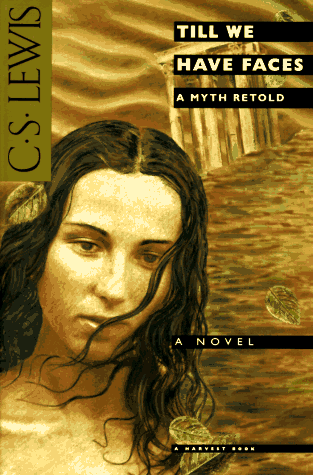
Till We Have Faces

Despite being his most neglected novel, C.S. Lewis's Till We Have Faces could be seen as his greatest theological work. It gathers together the diversity of his theological contributions into one highly enjoyable story. Unlike The Chronicles of Narnia, one does not feel as if C.S. Lewis were telling the Christian message in a thinly-veiled allegory. This is not to say that Lewis in this work does not provide for us a Christian message; he most certainly does. By the time he wrote Till We Have Faces, he came to understand that the best way to reach modern humanity was not to bludgeon them with Christian symbolism, but to reach them from the common moral and religious heritage that Christians inherited from the pagans. Thus, Lewis gives us in Till We Have Faces his theological ideals reworked so as to be placed under a completely pagan veil.

Indeed, while this methodological point is one which many do not realize that Lewis held, it is central to Lewis’ own re-conversion to Christianity and the common belief Lewis shared with his friend and co-mythopoet, Tolkien. Lewis realized that what lay behind pagan mythology was one grand story being told and proclaimed by them all, and that story had been realized as historical fact in the life and work of Jesus Christ. “Now as myth transcends thought, Incarnation transcends myth. The heart of Christianity is a myth which is also a fact. The old myth of the Dying God, without ceasing to be myth, comes down from the heaven of legend and imagination to the earth of history. It happens -- at a particular date, in a particular place, followed by definable historical consequences.” C.S. Lewis, “Myth Became Fact” in Undeceptions. (London: Geoffrey Bles, 1971), 42.

The pagan traditions, being pre-Christian, contained the mystery and wonder and excitement that preceded the Incarnation. In our modern age, post-Christian humanity has lost this sense of wonder; the world has become a dark, bleak place. In a letter to Blessed Don Giovanni Calabria, written in Latin, Lewis shows us this view with the following observation:

What you say about the present state of mankind is true: indeed, it is even worse than you say.

For they neglect not only the law of Christ but even the Law of Nature as known by the Pagans. For now they do not blush at adultery, treachery, perjury, theft and the other crimes which I will not say Christian Doctors, but the Pagans and the Barbarians have themselves denounced.

They err who say ‘the world is turning pagan again.’ Would that it were! The truth is that we are falling into a much worse state.

'Post-Christian man’ is not the same as ‘pre-Christian man.’ He is as far removed as virgin is from widow: there is nothing in common except want of a spouse; but there is a great difference between a spouse-to-come and a spouse lost.

---C.S. Lewis, The Latin Letters of C.S. Lewis. Trans. Martin Moynihan. (South Bend, Indiana: St. Augustine’s Press, 1998), 83-85.

Lewis significantly considered the possibility that the only way the world can be Christianized again is that we would first have to reconvert humanity back to the pagan traditions. “If they were Stoics, Orphics, Mithraists, or (better still) peasants worshipping the Earth, our task might be easier. This is why I do not regard contemporary Paganisms (Theosophy, Anthroposophy, etc.) as a wholly bad symptom.” C.S. Lewis, “Modern Man and his Categories of Thought” in Present Concerns . Ed. Walter Hooper (New York: Harcourt Brace Jovanovich, Publishers: 1986), 66.

Till We Have Faces is a re-telling of the Psyche myth under the hand of Psyche’s sister, Orual. In the myth, Psyche weds Cupid, the God of Love, and her sisters are jealous and try to end Psyche’s happiness by any means necessary. However, we find in Till We Have Faces Orual, the Queen of Glome, a woman who so loves her sister that she is incapable of believing her sister can be well without her. Her jealousy holds no evil intentions for Psyche, they are all good intentions; yet, as with all jealousy, they lead to an ill outcome ever the same.

The book is written in two parts, the first as a complaint to the gods, the second as her response and answer. In the first part we learn of Orual’s bitterness. Her beloved sister had been taken from her – she was led to believe Psyche had been sacrificed to the gods, only to find her alive and seemingly insane. Psyche claimed to be the wife of a god, living in a great mansion; when Psyche took her sister to her home, Orual could not see it; it looked to Orual as if her sister were living out in the open, and Psyche was seeing things which were not there. She struggled with her sister, tried to get her sister to see she was just living in the open wilderness, but nothing she did could convince Psyche, just as Psyche could not convince Orual about the nature of her new home.

Orual would learn, however bitterly, that her sister was correct, but only after she had caused such pain and sorrow to Psyche, effectively turning Psyche not only completely away from her, but from the God who really was her husband: Psyche became a wandering vagabond. In response to her bitterness, she blamed the gods for not letting her see what Psyche had seen – if she only had been given that same vision, saw things for what they really were, things would be different. However, she was to learn, her complaint not only was unjust, but was selfish; in her jealous love for her sister, she would have wished anything – even her sister’s death – to have been true more than what had really happened. Only by coming face to face to who she was in reality could she ever understand and experience the Gods, and when that happens, all answers come:

The complaint was the answer. To have heard myself making it was to be answered. Lightly men talk of saying what they mean […] When the time comes to you at which you will be forced at last to utter the speech which has lain at the center of your soul for years, which you have, all that time, idiot-like, been saying over and over, you’ll not talk about joy of words. I saw well why the gods do not speak openly, nor let us answer. Till that need can be dug out of us, why should they hear the babble that we think we mean? How can they meet us face to face till we have faces?

----C.S. Lewis, Till We Have Faces (New York: Harcourt Brace Jovanovich, 1985), 294.


C.S. Lewis had a profound insight to the nature of our relationship with what we call the “supernatural.” It is all around us and pervades our very life, but we are not open to it because we are not open to being truly who we are meant to be. We have not discovered who we are in ourselves.

We are like a block of marble, unformed, and our life becomes the means by which the marble takes form, slowly, chip after painful chip. God works in us and through us by his love, wanting to turn us into those people we are meant to be: to grow up, to love and be loved. Until we are, our experience of the world is imperfect and we go stumbling about life as if we were blind. We cannot truly see until we have faces – until our eyes are fully formed, capable of seeing things beyond the cataracts of our daily existence.

This belief, found throughout many of Lewis’ writings, finds itself in its best form here. We are shown through Orual’s story both sides of the equation. We first learn to experience and appreciate her sorrow and bitterness, to appreciate her complaint by experiencing her life through her eyes. We become Orual, and her complaint is the complaint of humanity against God: how detestable God must be; if only he would reveal himself to us, everything would be better. In showing us the inner psychology behind Orual’s complaints, and the consequences of her actions, we are shown the reasoning behind humanity’s complaint against God is at its core a shallow selfishness that closes us not only from God, but ultimately, from ourselves as well. At heart, it shows us the meaning behind Jesus’ words when he said, “He who loves his life loses it, and he who hates his life in this world will keep it for eternal life.” (John 12:25 RSV).

Labels: ,