With the arrogance of youth, I determined to do no less than to transform the world with Beauty. If I have succeeded in some small way, if only in one small corner of the world, amongst the men and women I love, then I shall count myself blessed, and blessed, and blessed, and the work goes on. -- William Morris

Tuesday, February 20, 2007

Charles Williams Quote

The central mystery of the Mass has been at all times the subject of dream and speculation, of theology and devotion. If it is the centre of Christian life, it is also and therefore, the centre of all life -- anyhow on this planet, and perhaps everywhere. For the mystery of the Redemption -- of which this is the sign and means -- lies close to the mystery of Creation. The Sacrifice of the Crucifixion was the unmaking of all life that it should be remade after the great original pattern; a deliberate unmaking instead of an inevitable decay. So far as chaos could come again upon a world in which God was immanent, so far in that darkness it came; wounding and overwhelming the Sacred Body, inclosing and darkening the Sacred Spirit within. It is the nature of Omnipotence always to be able to endure more and to go farther than the utmost that can be brought against him; and perhaps this is the nature of the last Judgement, that He leaves to every man the choice of dealings with Him. If a man will shape his life upon a basis of pride and anger, then he shall find a greater pride and anger in God; if he is covetous and robs others, God shall be covetous and rob him; if he is full of love, then God shall be full of love. The Mass is an invisible communication, not only of redemption but also of creation and judgement: it is an absorption of the communicant in his degree into eternity. It is therefore above all things the relation between his own soul and Love with which the lover is concerned; and though he passes into the mystery by the channels which Love has prepared, Love itself issues therefrom in all his terrible strength along the channels which the lover has prepared.


--Charles Williams, Outlines of Romantic Theology (Berkley, California: Apocryphile Press, 2005), 43.

Labels: , ,

Monday, December 11, 2006

Father Thomas Hopko On Liturgy

Quote of the week:

To explain the liturgy is like trying to explain a poem: if the meaning the poem is carrying could be completely explained, the poem wouldn't have been written in the first place. The written liturgy, like a genuine poem, is a term of reference; the real experience is beyond words. So I would say that the words and the rituals aren't necessarily our teachers. They are the means of access to the teacher. The teacher is the lived experience. In that sense, the liturgy is ultimately silent.

--- Thomas Hopko in Speaking Of Silence: Christians and Buddhists in Dialogue. Ed. Susan Szpakowski (Halifax: Vajradhatu Publications, 2005), 127.

Labels: , ,

Tuesday, September 26, 2006

Anamnesis

In my last discussion on memory, I ended with a brief discussion on communion and its relationship to memory. The following is a re-examination and continuation of that theme.
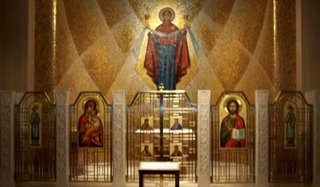


In the book of Hebrews, we are given an image of Jesus as the high priest who presents himself once and for all “in the presence of God on our behalf” (Hebrews 9:24b NRSV). The Apocalypse contains a vision of these heavenly rites, where the throne of God is surrounded by “four living creatures full of eyes in front and behind: the first living creature like a lion, the second living creature like an old, the third living creature with a face like a human face, and the fourth living creature like a flying eagle” (Revelation 4:6b-8). Beyond these four creatures are twenty four thrones, and upon each of these thrones there is an elder clothed with a white gown and a golden crown. Next, we find those who have been slain for the faith, the martyrs, in front of God petitioning him for his just judgment. Finally there appears an uncountable multitude from every nation, clothed also with a white robe, and countless angels of God. Coming together, they bow down in worship, praising God with the heavenly hymn. “Amen! Blessing and glory and wisdom and thanksgiving and honor and power and might be to our God forever and ever! Amen” (Revelation 7:12). Later there is another heavenly sign, that of “a woman clothed with the sun, with the moon under her feet, and on her head of crown of twelve stars” (Revelation 12:1). She brings forth “a male child, who is to rule all the nations with a rod of iron. But her child is snatched away and taken to God and to his throne” (Revelation 12:5).

These two visions relate one reality in two different perspectives. They show us two aspects of the one, eternal liturgical celebration and sacrifice performed by Jesus. The first gives us a glimpse of the liturgy as it is celebrated in the heavens. The second shows the earthly, human, side, where the eternal plan is lived out in the life of Jesus, from his birth to the point of his ascent into the heavens. The culmination of this mystical rite is shown to us at the end of the Apocalypse, where we are to experience the eternal presence of Jesus as God with us (cf. Revelation 22:1-5). In these glimpses of the heavenly and earthly work of Jesus, not only are we shown the countless saints before his throne, but we also see his all-glorious mother, Mary the Theotokos, the “queen in gold of Ophir” (Psalm 45:9).

Historically, it seems that the earthly elements of this liturgy have been accomplished once and for all in the distant past through the historical life, death and resurrection of Jesus. How then can we experience it ourselves? Yet if we do not, how will we be brought into the presence of God, which is the purpose of this liturgy?

This is where the category of memory comes into play. Because memory brings the presence of that which we remember to us, through memory we can participate, time and again, in the one, central, historical yet eternal act of Jesus. He told us that we should participate in this event at the Mystical Supper. “Do this in memory of me.” Do this each and every time you come together to worship me. When you do, you can experience eternal life even in your temporal existence by experiencing that one eternal heavenly liturgy. Join in with all of the angels and saints. They have their part in the celebration, just as you do. Do you not sense them with you?

The experience of the divine liturgy is the experience of heaven on earth. In its celebration we partake of the full heavenly liturgy as expressed in Scripture. We are drawn up to God through beauty. There are many ways that we can experience the splendor needed in our earthly worship to raise us up to the heavens. With beauty as our guide, we can reach the perfect anamnesis of God that can only be found in holy communion.

While the manner of the ascent might differ from church to church, or from liturgical tradition to liturgical tradition, the essentials are always the same. Experiencing the presence of Jesus in our community and in the spoken word of the Gospels, we share the fullness of his presence through communion. In our spiritual height we are not alone: we share the eternal banquet of the Lord not only with all who have gone before us but also all who shall come after.

“Remembering our most holy, most pure, most-blessed and glorious Lady, the Mother of God and ever-Virgin Mary, with all the saints, let us commend ourselves and one another, and our whole life, to Christ, our God” Liturgy of St John Chrysostom. By our act of remembrance, we experience the presence of the saints. Images in our churches, whether they are the icons in the Eastern tradition, or the statues in the Western tradition, are aids in experiencing their presence. This is what is meant when we say they are aids to our memory. They provide a focus for us to help establish that presence. They provide a way to break down the veil between heaven and earth, to help visualize the communion of the saints. “Visible things are corporeal models which provide a vague understanding of intangible things,” St John of Damascus, On The Divine Images. Trans. David Anderson (Crestwood, New York: St Vladimir’s Seminary Press, 1994), p.20. The heavenly realm is intangible to us, and yet we are called up to it in the beauty that surrounds us by the holy images found in our churches. Indeed, icons represent more than their earthly glory, but are seen as representing the saints in their deified, form.

It is important for us to have images around us. We are bodily creatures, and our bodies must be engaged. Presence in mind is one kind of presence; presence experienced through the senses is another. The second engages the first. “A certain perception takes place in the brain, prompted by the bodily senses, which is then transmitted to the faculties of discernment, and adds to the treasury of knowledge something that was not there before.” Ibid.

Eastern churches in their architecture also try to represent many aspects of our communion with the saints. Painted on the entry can be an icon of Jesus Christ. “I am the gate. Whoever enters by me will be saved, and will come in and go out and find pasture” (John 10:9). The pillars holding up the frame of the building have images of the martyrs, whose strong faith held the church together in times of persecution. The iconostasis in the front of the church represents the barrier (never entirely closed) between heaven and earth, with the saints encouraging us, showing us the blessed reward being prepared for us. We can be there with the saints in the presence of the Lord. Indeed, we are there when we celebrate the liturgy.

“May the Lord God remember in His kingdom, Our Holy universal Supreme Pontiff N . . ., the Pope of Rome, our most reverend Archbishop and Metropolitan N . . ., and our God loving Bishop N . . ., and the entire priestly, diaconal, and monastic order, our civil authorities, and all our armed forces, the noble and ever memorable founders and benefactors of this holy Church, (our suffering brethren), and all you orthodox Christians, always, now and ever, and forever” Liturgy of St John Chrysostom. Just as we remember the Lord and the saints, bringing their presence to us, we must in turn bring ourselves to the Lord, to be remembered by him, to have our presence preserved in his eternal memory. The heavenly liturgy is not just God’s presence with us, but our presence with God. It is not just our memory of God, but God’s memory of us. Communion is the celebration where the two become one. Nor is it an individual event, where we alone are preserved in God’s memory, as we can see in the prayers offered by the priest in the Liturgy of St John Chrysostom:

Priest (silently): For the holy prophet, precursor and Baptist John, for the holy glorious and illustrious apostles, for Saint N . . ., whose memory we celebrate, and for all Your saints, through whose prayers, O God, visit us. Remember also all who have departed in the hope of resurrection unto eternal life. (Priest mentions those deceased he wishes to remember) And grant them rest where the light of Your face shines.

Moreover, we pray you, O Lord, remember the entire episcopate of the orthodox, who faithfully dispense the word of Your truth, the entire priesthood, the diaconate in Christ, and all others In holy orders.

We further offer You this spiritual sacrifice for the whole world, for the holy, Catholic, and Apostolic Church, for those who live in chastity and venerable conduct; for our civil authorities and for all the armed forces. Grant them, O Lord, a peaceful rule, that we also, sharing their tranquility, may lead a tranquil and calm life in all piety and dignity.


If memory is presence, then beauty is the means by which we experience this presence. Through beauty, the spiritual epiclesis, communal remembrance is more than a mere mental recollection. “The beauty of the world is an effect of the Holy Spirit, the Spirit of Beauty, and Beauty is Joy, the joy of being” Sergius Bulgakov, The Comforter. Trans. Boris Jakim (Grand Rapids, Michigan: Eerdmans, 2004), p. 201 The Holy Spirit, the Lord of Life, the Great Artist, the Lord of Beauty, in its descent upon the gifts offered at the altar clothes Jesus through them by the beauty inherent in the eucharistic rite. “O Lord my God, you are very great. You are clothed with honor and majesty, wrapped in light as with a garment” (Psalm 104:1). Beauty is the means by which we ascend to God, but it is also the means by which God comes down to us. Thus through the beauty of liturgy we find the fulfillment of memory, and the presence of heaven with all the saints is experienced here on earth.

Labels:

Thursday, September 21, 2006

Eternal Memory

Eternal memory. Eternal memory. Grant, 0 Lord, to Your servant blessed repose and eternal memory.
In the Byzantine tradition, both funeral services and memorial services for the dead, except during the Paschal season, end with prayers asking for the deceased to be in God’s eternal memory. For many unfamiliar with this tradition, this request might seem strange. Is it possible for an omniscient God to forget someone?

The problem lies with the way we understand memory. For us, memory is merely the mental recollection of a phenomenon we have previously experienced. To remember someone is to think about them, bringing to mind whatever qualities and characteristics which we associate with their being. We might ponder the way they looked, how they used to act, or some spectacular deed they did. Yet, there are always aspects we forget. Memory is an imperfect mental reconstruction of the past which is now non-existent. Once a moment of time has past, it is gone. Only the now is real. Thinking about the past does not make it come back to life.

While a reflection of people, places and things which once existed in the past is indeed a part of the process of memory, to consider memory solely in this fashion is not to understand what the ancient world, and therefore the authors of Scripture (and their heirs who developed the Christian liturgical tradition), meant by it. Memory was an act of presence: to be in God’s memory was to be present with God. Those who remembered you preserved your presence on the earth. It was a great blessing to be remembered, because while someone remembered who you were, you continued to live. To be forgotten was to perish. “The memory of the righteous is a blessing, but the name of the wicked will rot” (Proverbs 10:7, NRSV). When God remembers someone, he preserves them. “But God remembered Noah and all the wild animals and all the domestic animals that were with him in the ark” (Genesis 8:1). When God remembers a covenant, he acts upon it, doing whatever is necessary to keep it intact. “After a long time the king of Egypt died. The Israelites groaned under their slavery, and cried out. Out of the slavery their cry for help rose up to God. God heard their groaning, and God remembered his covenant with Abraham, Isaac, and Jacob. God looked upon the Israelites and God took notice of them” (Exodus 2:23-25). In the Torah, we find the blotting out of one’s memory to be God’s greatest curse. When Israel was attacked by Amalek, God’s response was to say, “I will utterly blot out the remembrance of Amalek from under heaven” (Exodus 17:14b).

The Torah calls us to remember the Sabbath and keep it holy. It is not a command to merely reflect upon some past Sabbath day, it is a call to re-experience the holiness of the Sabbath each and every Sabbath. When the Passover was celebrated by the Israelites, it was understood that they were re-experiencing the original Passover.

We can understand many of the words of the prophets in this context. Recognizing Israel’s apostasy, they asked God to remember his covenant with the patriarchs. “We acknowledge our wickedness, O Lord, the iniquities of our ancestors, for we have sinned against you. Do not spurn us, for your name’s sake; do not dishonor your glorious throne; remember and do not break your covenant with us” (Jeremiah 14:20 -21). Yet, how is God to do this when Israel has sinned against him? Did he not promise retribution for disobedience? When sin is remembered by God, it is in his presence, and it will bring out his wrath.

The solution was simple. Sin had to be blotted out. “Hide your face from my sins, and blot out all my iniquities. Create in me a clean heart, O God, and put a new and right spirit within me” (Psalm 51: 10 – 11). Sin is forgotten by God, that is, he removes it from his presence. “I, I am He who blots out your transgressions for my own sake, and I will not remember your sins” (Isaiah 43:25).Fundamentally, there is an ontological change in the subject, and the sin itself no longer exists. We are told he does this because he remembers his first covenant. It is from the first and its continuation that a second is established. “Yet I will remember my covenant with you in the days of your youth, and I will establish with you an everlasting covenant […] I will establish my covenant with you and you shall know that I am the Lord, in order that you may remember and be confounded, and never open your mouth again because of your shame, when I forgive you all that you have done, says the Lord God” (Ezekiel 16:60; 62-3).

When we turn to the New Testament, we continue to see memory understood by this Semitic approach. We also see a development of what it means to remember coming from the Hellenistic context in which the New Testament was written. We find in the Apocalypse a very Jewish approach towards salvation and damnation. Here the saved are found written in the Lamb’s Book of Life (cf. Rev 3:5; 20:12; 20; 21:27). Their names are remembered, giving them life eternal. In the Torah, God said, “Whoever has sinned against me I will blot out of my book” (Exodus 32:33). In the Apocalypse we see what will happen if that threat is carried out: “anyone whose name was not found written in the book of life was thrown into the lake of fire” (Revelation 20:15). One whose name is forgotten perishes; one who is remembered will be given the heavenly reward – they will experience eternal life in the very presence of God.

“Remember Jesus Christ, raised from the dead, a descendent of David – that is my gospel” (2 Timothy 2:8). Only by this traditional understanding of memory as presence, can the gospel be said to be established by the remembrance of Jesus. While the presence of Jesus in our life is established interiorly through our memory, we find his presence in our community through our communal memory. “For where two or three are gathered in my name, I am there among them” (Matthew 18:20). Just as we found out that the preservation of our names in the Book of Life indicates God’s remembrance of who we are, to be gathered in Jesus’ name is to gather so we can remember him. It is through remembrance we get his presence. It is also through remembrance we have communion, one with another, in the Lord. “We always give thanks to God for all of you and mention you in our prayers, constantly remembering before our God and Father your work of faith and labor of love and steadfastness of hope in our Lord Jesus Christ” (1 Thessalonians 1: 2-3).

While memory signifies presence, we must admit that there are many ways we can experience this presence. Even when we are physically before one another, we can experience each other’s presence in a multitude of ways. Each way is unique. However, the greatest, purest act of remembrance of Christ comes through the new paschal meal he established before his death. He told us that when we come together, we are to perform this meal in remembrance of him. To fully understand the New Testament understanding of remembrance, we must appreciate the implications of the Greek work anamnesis which is being used. “It is a recollection of the past that enlivens and empowers the present as well. Such memory is not restricted to the mental activity of individuals; it is found above all in the ritual and verbal activity of communities” Luke Johnson, The Writings of the New Testament (Philadelphia: Fortress Press, 1986), 114-5. It is truly a re-collection, re-establishment, a re animating or “member”-ing of Jesus’ presence, the ongoing presence of Jesus as the bread of life (John 6:51).

Our memory is imperfect. Through memory we experience the presence of others relative to how well we remember them. But, through the Holy Spirit, the Lord and Giver of Life, that which is imperfect is perfected. The Spirit, through the order established by God the Father, through the work of his Son, is fully capable of bringing that Son, Jesus, to us. The bread we bring to share with one another as the remembrance or re-collection of Jesus becomes that very presence through the work of the same Spirit who turned dust into life. In communion we find not only the perfect presence of Christ, but the perfection and end of memory itself. “Those who eat my flesh and drink my blood have entered eternal life, and I will rise them up on the last day; for my flesh is true food and my blood is true drink” (John 6:54-5). In our communal remembrance of Christ, we find Christ remembers us – in communion we find eternal life, that is, eternal memory. Remember me, O Lord, when you shall come into your kingdom!

Labels: ,

Friday, September 01, 2006

More Considerations on Liturgy as Definition

By way of response to some of the comments posted in reply to my last post, all of which intend to deepen and flesh out our understanding of Liturgy, I offer the following thoughts.

Quasi-Liturgy (things such as rituals, experiences, and examples from groups more or less related to the Church) need not distract us. Whatever is genuine about man must find a source and summit in Liturgy. IN whatever way other societies have come into genuine human contact, they have seen the image of God, and their communal life has approached Liturgy.

In order to separate the Sacraments/Liturgy (in actu) from Sacramentality (in potentia), we can turn to God’s saving presence and the presence of Christ in his Body. That is, we might be tempted to think that all activities which tend toward uniting man as Body/Soul also tend towards Liturgy. Furthermore, that they tend toward Liturgy in a way that makes it difficult to accept this as the heart of the Church since these things happen outside the Church. We must not forget that the definition of a Sacrament always involves this sense of being fully human, but that humans have this innate purpose or goal which is to grow ever closer to the God in whom they exist in relation.

The Eucharist as one of seven sacraments is not coextensive with Liturgy, which surrounds all seven. The Eucharist as the form of Liturgy is coextensive, and it is this patter which is Liturgical; which is Catholic; which is love, fueled by Faith and led by Hope. The mystery of the Eucharist extends well beyond the necessary belief in Christ’s Real Presence because this awesome presence is a mystery. Most poignantly, Christ sets the pattern for theandric love, that is, love between God and Man. I attempted to call special attention to the fact that Creed and Moral exhortation and example resolve to Liturgy in a theological understanding. This is reason I offer Liturgy as a definition for Catholics. The other is because Liturgy is the fundamental pattern for Christian life-this pattern is one in which God gives-man receives-man gives-God receives. Consider the beginning of the Eucharistic Liturgy, which in the Latin Rite involves these words: “Blessed are you, Lord, God of all creation, through your goodness, we have this bread to offer you, which earth has given and human hands have made. It will become for us the Bread of Life.”

A good friend pointed out in a more private context that the theme of communio is vitally important. He is right. Communio as a theme for Ecclesial definitions cannot be ignored, for it is the model of the Trinity which is the model of the Church and Salvation. But can it not also be said that “God is Love” (1 Jn 4:8), and, further, that this is the meaning of communio? It is certainly the meaning of the sense of communio which is captured by the Law-Torah-Covenant (Mt 22:34-40, in which Jesus offers the Greatest Commandment). It is certainly the meaning of communio explained by the Mystical Doctors of the Church. It is certainly the meaning of “This is my Body,” spoken by Christ on the Cross, the priest at Mass, and spouses to each other.

Again, I call attention to Liturgy as a definition for Catholics because it exists in the category of presence: Eternal Present; Real Presence, my unique and particular place in the world as it unfolds and includes my choice to stand here and be among the People of God. This is how we love: we are. Perhaps there is no greater mystery than that of existence, and the must be because of the relationship between love and being. Liturgy is the when and where of the playing out of this nexus day after day, year after year, life after life.

Labels: ,

Monday, August 21, 2006

Defining Catholicism

Many years ago, while working with the Rites of Christian Initiation for Adults, I became very curious about what defined a Catholic. In particular, I reflected upon what the Church asks of those who seek to join her at the most profound and intimate level. Since then, I’ve had extensive discussions with theologians and canonists of various degrees of expertise. A common position is that Catholicism is defined by her teachings, in particular, by her dogmatic statements. That is, those elements of doctrine (teaching) which have been officially stated as crucial (dogmatic) to the Faith are often considered the definition of Catholicism. It makes a bit of sense, too, for definitions are typically a series of key points, and doctrine seems to state clearly the key points.

Another common understanding of what defines a Catholic revolves around the moral code. Catholics are among the groups of Christians who have quite a few rules and regulations on what constitutes appropriate behavior and what does not. The field of moral theology seems to be quite developed and quite important for Catholics. There are many who think the essence of being Catholic lies somewhere in the kind of life you lead, even more than the doctrine you profess. This, too, has a common sense appeal to it, for a definition is often a series of rules that describe how a thing is supposed to work.

There are, of course, the great many Catholics who feel somewhere deep inside them that they are Catholic and can’t really be anything else. Nevertheless, they don’t feel a need or really much desire to participate in regular Sunday Mass or other activities of parish life. Perhaps on great feast days or for important family celebrations they seek the larger Church community. Basically, their position is that they were raised Catholic, Baptized Catholic, even Confirmed Catholic. What has happened cannot be taken away. This has a very easy and comfortable feel to it, as well, for being Catholic is something being a man or a woman-it usually just happens to you, and there’s not much you can really do about it but accept it.

As an aspiring professional theologian, I cannot reasonably claim that doctrine is unimportant. The battles fought over creedal statements, even things we take as common sense Christianity (such as the Trinity or the Resurrection) were and continue to be a cause of disagreement and even martyrdom. The Creeds and the surrounding doctrine are important, but I do not think they define a Catholic at the very core of Catholicism. In a similar manner, the moral life is not the sum or defining characteristic of Catholicism. Not that one can disregard the Commandments and remain hopeful for eternal salvation, but rather, that one can genuinely hope to be changed, to find himself with a will that is united to God-this is the sphere of morality in Catholicism. Yet, even this kind of hope for a better existence does not define a Catholic. The case, as I see it, remains similar with the mentality of “once a Catholic, always a Catholic.” This perceptively and correctly understands what theologians have long called the permanent character of certain sacraments, but it still fails to grasp the heart of Catholicism as I have come to understand it. One need not understand the depths of the mysteries of the Church and the Resurrection, which depend upon the ultimate and primordial mystery of the Trinity, in order to be Catholic. The Church exists for the sinners to become saints. Sacraments are essential and often permanent, but they are not static.

I suggest that Liturgy is what defines Catholics. By “Liturgy,” we mean the public act of worship in which the community gathers and acts as the Body of Christ. The Creed, you will note, exists first and foremost as a liturgical reality. The most grave penalty for teaching contrary to orthodoxy (which literally means something like “proper worship”) is excommunication-to no longer be part of the Liturgical action. The source and summit of the moral life is the Liturgical action of gathering with the people of God and being nourished by the Sacred Scriptures and the Sacraments. Indeed, the Sacraments only occur within the context of Liturgy, however small that Liturgy may seem.

But the ubiquity of Liturgy as a theological theme is not why I think Liturgy defines Catholicsm. In the end, I think the ultimate theological formula for Catholics is the appeal to the theological virtues, the triad of Faith, Hope, and Love. Liturgy is the action of the faithful: Liturgy is the action of the hopeful: Liturgy is the action of lovers; For it is in Liturgy that we gather, sometimes even when we know not why. When we come to Liturgy, especially the Mass and the Eucharist, we say with our very presence that we genuinely want to experience the God who saves us, especially from our own deepest, most secret fears and failings. We say, by our presence in the pew, “I need not understand; I need not always enjoy; I need not even be certain; I simply must be. And I chose to be here with this community, in this place of worship, at this time of God’s presence.” This is both why and how Liturgy defines the Catholic.

Note that it is very much the same for how a lover is defined. A lover is not defined by expensive gifts or by profound understanding. A lover is defined by presence. A true lover is known by where he sits, stands, and kneels. This is something we know even without much reflection. To be friends, to be lovers is to be together. It is not necessarily to be happy or to understand. Lovers stand beside lovers and say “I cast my lot with you.” In Liturgy, we say to God, “I cast my lot with you,” and God says to us, “I cast my lot with you.” This, I think, is the meaning of being “God’s people.” This is how we follow Christ. This, I submit, is what defines Catholicism.

Labels: ,